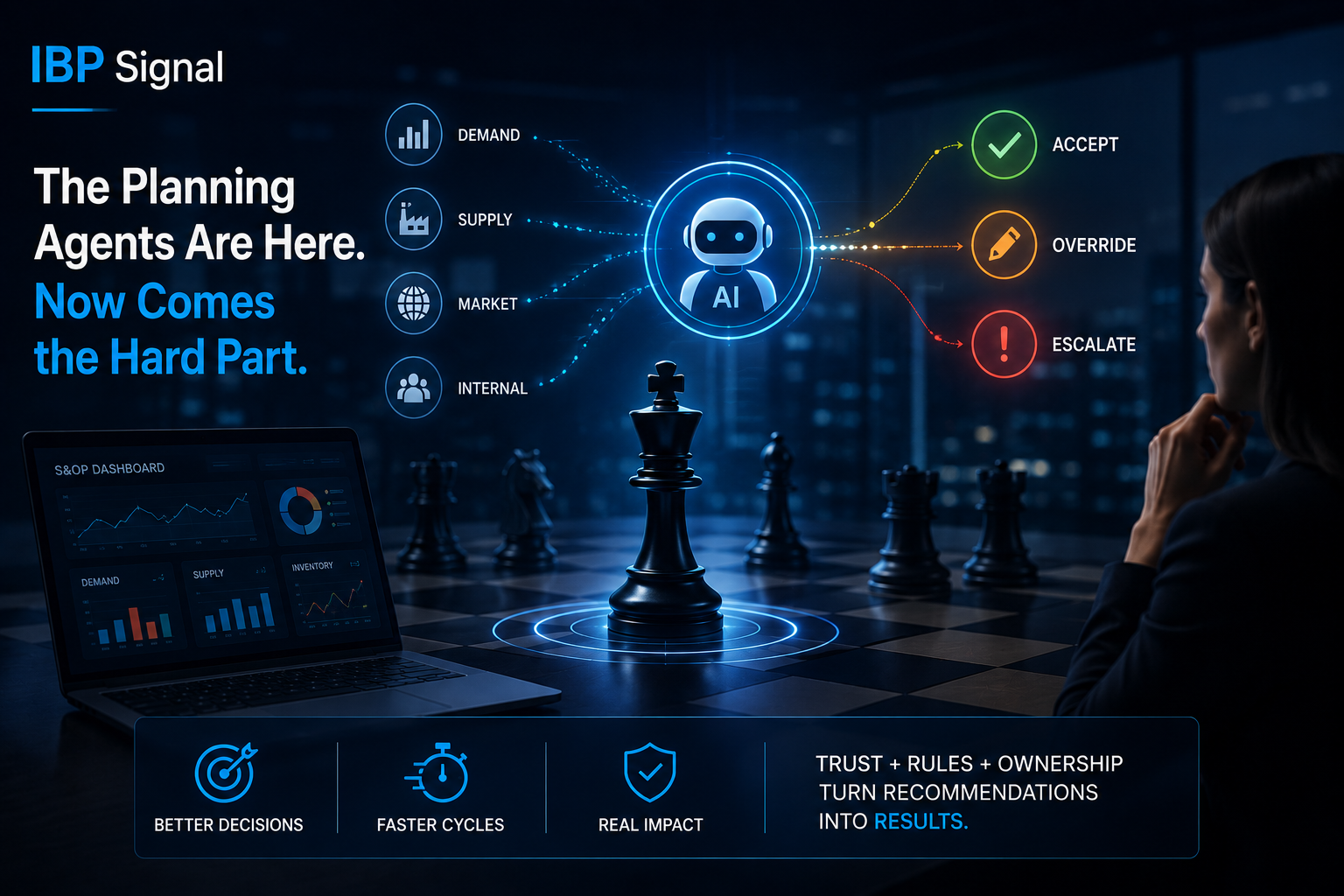
On July 31, Stephan Kreipl, head of product management for SAP IBP, announced the 2608 release: a major platform update that brings AI-driven harmonized planning into live IBP cycles. The release is not a roadmap slide. It is moving into release with agentic capabilities planned around the August 2026 rollout.
For SAP shops, this means planning agents will soon sit inside the same S&OP workflow they already run: generating recommendations, flagging exceptions, and, in theory, shortening the cycle between signal and decision.
SAP is not alone. Oracle has announced agentic applications for supply chain workflows. Board has introduced supply-chain and merchandiser agents for continuous planning. Anaplan has launched its Agentic Enterprise model for finance and planning decisions. o9 is pushing the planning conversation toward APEX and natural-language planning workflows, where a manager asks a question and receives a scenario rather than another dashboard.
The pattern is clear. After two years of AI pilots and proof-of-concept fatigue, major planning vendors are moving agentic products into the planning workflow. The technology is no longer the main bottleneck. The harder problem begins when an agent recommends a demand shift, supply reallocation, or exception escalation, and the planner has to decide whether to act.
Accenture's supply-chain Pulse of Change coverage adds the leadership context: 76% of global supply chain executives anticipated continued higher levels of change and disruption in 2026. IndustryWeek has also captured the operating tension around AI and supply-chain silos. That pressure lands directly on the IBP cycle: can the organization act on what AI surfaces before conditions change again?
When an agent suggests a demand override that contradicts the sales forecast, or a supply switch that violates sourcing strategy, the planner is not facing a technology problem. They are facing a decision-rights problem inside a compressed cycle.
Pattern Detected: The planning handoff nobody owns
That is where exception governance becomes the real planning discipline.
When an agent recommends a demand override or supply reallocation inside an IBP cycle, the planner is not short of data. They are short of rules. Capgemini's S&OP research supports the broader point that agentic AI needs clear process boundaries and human decision ownership. Oliver Wight's IBP perspective points in the same direction: sales signs off, operations confirms, finance constrains, leadership commits.
Agentic AI compresses that friction. It does not replace the sign-off logic. If that logic is missing, compression becomes noise: more recommendations, faster debates, and fewer committed decisions.
Tool Check: Agentic planning modules
The tactical breakpoints are already visible. In demand sensing, an agent may flag a demand spike before the sales forecast catches up. In supply reallocation, an agent may recommend shifting volume based on lead-time risk while sourcing strategy points the other way. In scenario simulation, the agent can run a what-if in seconds while the business still needs hours to align on assumptions.
Not every AI recommendation should carry the same governance. A minor inventory adjustment and a major demand-plan change should not move through the same approval path. Decision authority has to scale with the materiality and business impact of the recommendation.
Accept / Override / Escalate
Accept: The planner can accept the recommendation when it sits inside predefined operating tolerances and does not cross a material business threshold. Use it for limited forecast adjustment, small inventory reallocation, routine exception resolution, or low financial/customer impact.
Override: The accountable owner can override when relevant business information or constraints are not represented in the recommendation. Use it for customer promotion, commercial negotiation, sourcing commitment, strategic customer decision, operational constraint, or fresh market intelligence. The reason must be recorded.
Escalate: The recommendation moves to the relevant decision owner when it exceeds an agreed materiality or decision-rights threshold. Use it for financial impact, revenue at risk, customer/service impact, inventory exposure, capacity implication, strategic supplier implications, or significant deviation from the consensus plan.
Materiality Point
The materiality point is the guardrail that prevents every exception from becoming a war room.
Below it: the accountable owner decides. Above it: the recommendation escalates to the agreed decision forum. The threshold is company-specific; do not copy someone else's number.
The governance model should not stop after the decision. Each cycle should review what was accepted, what was overridden, why overrides happened, what repeatedly escalated, and where the agent repeatedly missed business context.
Those patterns tell leaders whether they have a model problem, a data problem, poor threshold design, unclear decision rights, or a process problem that AI has simply made more visible. That is what trust architecture means operationally: decision rights, materiality thresholds, override justification, escalation paths, and a feedback loop inside the IBP rhythm.
Question Worth Asking
For each agent-generated recommendation: what can the planner accept, what requires a recorded override, what must escalate, and where is the outcome captured?
If one of these is missing, the output is not yet decision-ready.
One Signal: Decision activation is the new bottleneck
The next planning advantage is not better algorithms. It is better decision activation: the discipline to convert AI recommendations into committed, traceable actions inside the existing S&OP cycle.
Your Cycle This Week
Choose one AI-assisted planning workflow you already use or are evaluating: demand sensing, supply reallocation, exception management, or scenario planning.
Draft a one-page operating rule for that workflow. Define what can be accepted, what can be overridden, what triggers escalation, who owns the decision, what override rationale or evidence is required, what materiality threshold applies, and how often the pattern will be reviewed.
If the answer is unclear, the agent is not the problem. The rule is.
IBP Signal is a weekly decision briefing for IBP, S&OP, and supply chain planning leaders. If this was useful, forward it to one planning leader who owns the cycle, not just the dashboard.
Sources
- SAP IBP 2608 launch announcement, Stephan Kreipl, July 31, 2026.
- Oracle Fusion agentic SCM applications, June 29, 2026.
- Board supply-chain and merchandiser agents, June 24, 2026.
- Anaplan Agentic Enterprise, June 30, 2026.
- o9 APEX planning model and Vibe Planning, 2026.
- Accenture Pulse of Change, July 2026.
- IndustryWeek AI and supply-chain silos coverage, July 30, 2026.
- Capgemini, Agentic AI in S&OP.
- Oliver Wight, AI and the IBP process.
- E3 Magazine, SAP IBP agentic AI use cases.