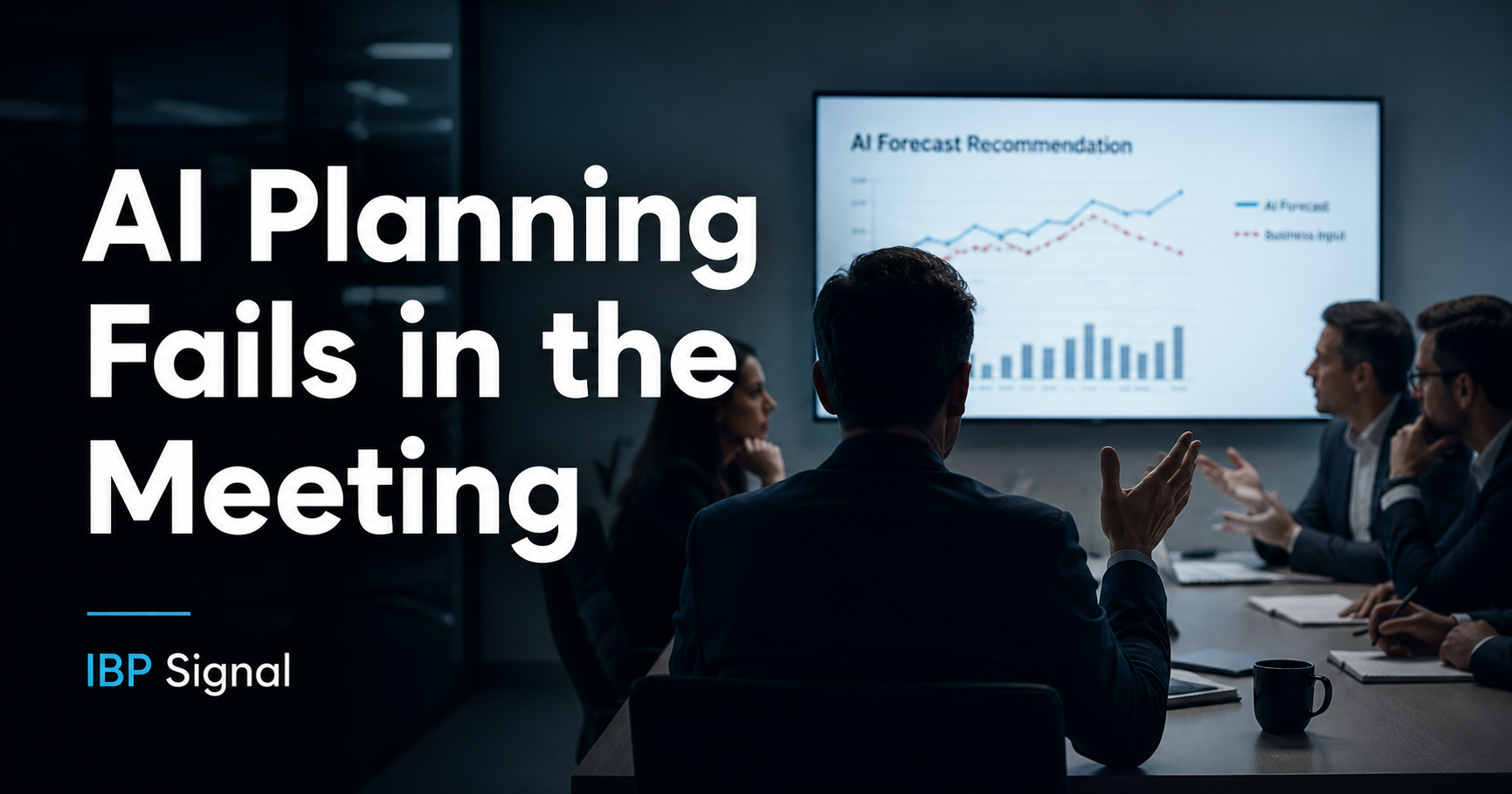
Consider a large industrial manufacturer that recently signed off on its third AI planning pilot in eighteen months. The first two delivered cleaner dashboards. Neither changed who owns the decision when the algorithm conflicts with business judgment. In last quarter's Executive IBP, the same product-family forecast bias was still there, now dressed in a machine-learning confidence interval and a prettier chart. The demand planner had run the model. The sales director had adjusted the output. The supply team had never seen the original recommendation. The cycle had absorbed the technology without changing the politics.
According to BCG research on supply chain planning (February 2026), most companies lack the organizational operating system-clear decision rights, escalation rules, planner-AI collaboration models-to make AI investments pay off. BCG separates planning leaders from laggards not by algorithm budget, but by whether governance was redesigned before the tool was deployed.
The planning gap in 2026 is not a data-science problem. It is a meeting problem. When AI recommends a demand number and Sales disagrees, who owns the assumption? When supply flags a capacity constraint and the algorithm optimizes around it, does that constraint reach Reconciliation before the scenario is politically locked? In many cycles, the answer is no. The AI produces a statistically refined forecast. The existing process around it produces the real number that reaches the executive dashboard. The algorithm becomes expensive decoration.
This matters because the next budget cycle is approaching. If your company is evaluating another AI investment, the due diligence question is not whether the model is accurate. It is whether the S&OP cycle can absorb a machine recommendation without breaking the ownership structure that already exists. If governance is unclear, AI does not fix it. It accelerates the wrong decisions with higher confidence.
In Monday's cycle, test one AI-generated number with three questions:
- Who owns the assumption?
- What constraint would invalidate it?
- What trigger date forces a decision?
If one of these three is missing, the AI output is not yet decision-ready.
Pattern Detected: The AI handoff that is not really a handoff
This pattern appears when companies deploy AI on top of broken S&OP processes. The algorithm produces a number, but the process around it-who challenges it, who owns the assumption, who escalates when it conflicts with judgment-has not changed. The handoff from model to human is treated as automatic rather than governed.
In practice, the planner becomes a rubber-stamper. The AI recommendation goes straight to the executive dashboard because the cycle never built a challenge step. The tool may be accurate. The process is blind.
Watch for the moment when an AI-generated scenario reaches Reconciliation without a named owner who has explicitly signed off on the assumptions behind it. If that owner does not exist, the pattern is active.
Tool Check: AI scenario dashboards
They are supposed to show trade-offs. In many cycles, they become decoration because the scenarios are built after the decision is already politically settled. A Lenovo case study in Harvard Business Review (May 2026) illustrates what happens when the foundation is built first: AI works because the process owns the decision, not the tool. The difference is not the dashboard. It is what happens before it is generated.
In the more common failure mode, the tool shows five scenarios but the meeting already knows which one the CEO wants. Nobody names the real constraint because it was decided in a side conversation two weeks earlier.
Try forcing each scenario to include one decision owner, one binding constraint, and one trigger date before the tool generates output. If the scenario cannot pass that test, the gap is not in the software.
Source: Harvard Business Review, "How Lenovo Built an AI-Powered Supply Chain," May 2026, https://hbr.org/2026/05/how-lenovo-built-an-ai-powered-supply-chain (paywalled). Public summary confirms foundation-first approach.
Question Worth Asking: "What would have to be true for this AI recommendation to be actionable in Monday's cycle?"
Ask it in Supply Review before the number reaches Reconciliation. Good answers name a decision owner, a binding constraint, and a trigger date. Weak answers repeat the algorithm's confidence interval.
The question exposes whether the AI output has a process home. A recommendation without an owner, a constraint without a boundary, and a trigger without a date will not survive the first executive challenge. It will be overruled, and the cycle will learn to treat the AI as background noise.
If nobody in the room can name the owner, the useful move is not to distrust the algorithm. It is to distrust the handoff and fix the ownership gap before the next model is deployed.
Operating Context: Semiconductor supply structure
Moody's (May 2026) reports that global semiconductor sales reached $790 billion in 2025, up 25.6% from 2024. TSMC's market share is close to 70%, with Samsung at around 7%. The binding constraint in many cases is not only fab capacity. It is supply chain structure: concentration risk, fragile upstream suppliers, and long qualification cycles that no algorithm can shorten.
For IBP leaders in electronics, automotive, and industrials, your AI demand forecast is only as good as your supplier risk signal. Generic advice says invest in AI demand sensing. The reality: if your single-source exposure is not visible before Reconciliation, the AI is optimizing for a supply plan that cannot execute. The global playbook works. The timing does not survive the supplier lead-time reality.
Source: Moody's Investors Service, "Semiconductors in 2026: Why Supply Chains Are a Major Bottleneck," May 2026, https://www.moodys.com/web/en/us/insights/corporations/semiconductors-in-2026-why-supply-chains-are-a-major-bottleneck.html
One Signal: Planning is now an enterprise capability
BCG's 2026 supply chain planning research makes clear that AI and advanced planning systems are not enough. The companies seeing real value invested in the operating system first: people, processes, data, and governance. Planning is now a strategic capability, not a technical function. The leaders separated themselves by redesigning how decisions flow, not by buying better algorithms.
Source: Boston Consulting Group, "Supply Chain Planning 2026: Why AI Alone Isn't Enough," February 2026, https://www.bcg.com/publications/2026/supply-chain-planning-why-ai-alone-isnt-enough
Regulatory Watch: EU Omnibus I
The EU published Omnibus I in its Official Journal on February 26, 2026. CSDDD core due diligence obligations remain intact despite scope reduction and simplification. The July 2029 application deadline stands. For IBP leaders, the headline simplification is not the signal. The signal is that supplier due diligence is now locked in law, and while scope and timing elements may shift through implementation, the direction for supply chain risk assessment is clear. If your S&OP cycle does not yet include a supplier risk screen before Reconciliation, the compliance gap is widening. Integrate due diligence triggers into your Supply Review cadence now.
Source: Covington & Burling LLP, "EU CSDDD/CSRD Omnibus Published in Official Journal," February 27, 2026, https://www.cov.com/en/news-and-insights/insights/2026/02/eu-csddd-csrd-omnibus-published-in-official-journal-transposition-delegated-acts-and-guidelines-are-next