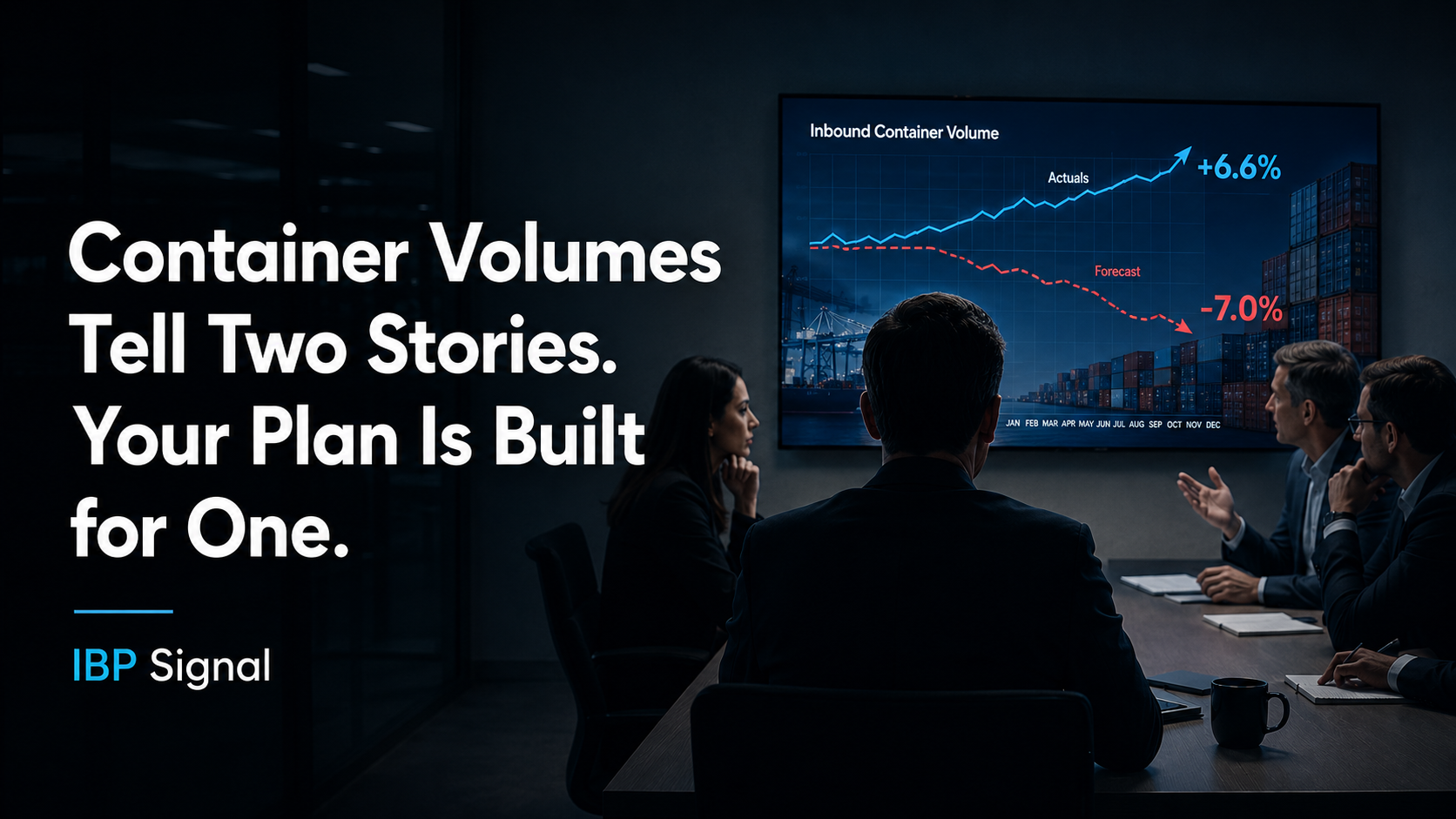
Two headlines this month. One says U.S. container import volumes rose 6.6% in May. The other says the Port of Los Angeles expects a 7% decline.
Both are credible. Both are current. And both cannot be true for the same plan.
The May increase comes from Descartes, which tracks actual inbound flows. The decline comes from the Port of Los Angeles budget forecast, which projects fiscal year 2026-2027. One looks backward at what arrived. The other looks forward at what is expected. The problem for IBP is that the operating plan must bridge both views, and most plans are not built to absorb this kind of contradiction.
The planning risk is not which forecast is right
Forecast disagreement is normal. What matters here is that the two signals describe different time horizons and different operating questions. Actual inbound growth can coexist with a forward-looking decline. The risk is that a single consensus plan averages the contradiction away and leaves the organization prepared for neither state.
In a classic planning cycle, volume uncertainty is often handled as a high, base, and low demand view. That is not enough when the operational implications move in different directions. A short-term import rise can create capacity pressure, demurrage exposure, and warehouse congestion. A forward decline can trigger underutilized contracts, lower replenishment confidence, and supplier-order hesitancy. The plan needs to hold both possibilities long enough to decide what would change.
Build paired scenarios, not a blended answer
Paired scenarios force the team to keep two credible states alive at the same time. Scenario A asks what happens if recent inbound momentum continues and the network absorbs more volume than expected. Scenario B asks what happens if the port forecast is the better early signal and demand softens through the next planning horizon.
The value is not in proving one scenario correct. The value is in identifying decisions that are robust across both. If both scenarios require the same expedited capacity, that decision can move. If one scenario requires inventory buildup while the other requires cash protection, the decision needs an explicit trigger.
The fuel and modal multiplier
Container volume is rarely a standalone signal. Fuel, routing, and modal availability can multiply its impact. A plan that assumes stable ocean cost, stable drayage availability, and stable inland movement may look balanced on paper while hiding a network exposure that only appears when volumes shift quickly.
This is why Demand Review and Supply Review need to connect the macro signal to operational constraints. The question is not simply whether demand is up or down. It is which lanes, suppliers, customers, and inventory positions become fragile if the wrong volume assumption is used for four more weeks.
Three Demand Review questions
- Which customer or product-family plans depend on the import-growth signal being the better guide?
- Which cost, capacity, or inventory decisions depend on the forward-decline signal being the better guide?
- What trigger tells us to switch from one operating state to the other before Reconciliation?
If the answer is "we will monitor it," the plan is not ready. Monitoring is not a decision rule. The cycle needs the trigger date, the decision owner, and the action that changes when the signal moves.
For another example of structural supply uncertainty, see Issue #2 on semiconductor bottlenecks as an IBP scenario-planning problem.