Lead Signal
Supply chain leaders are not short on analysis. They are short on reversibility.
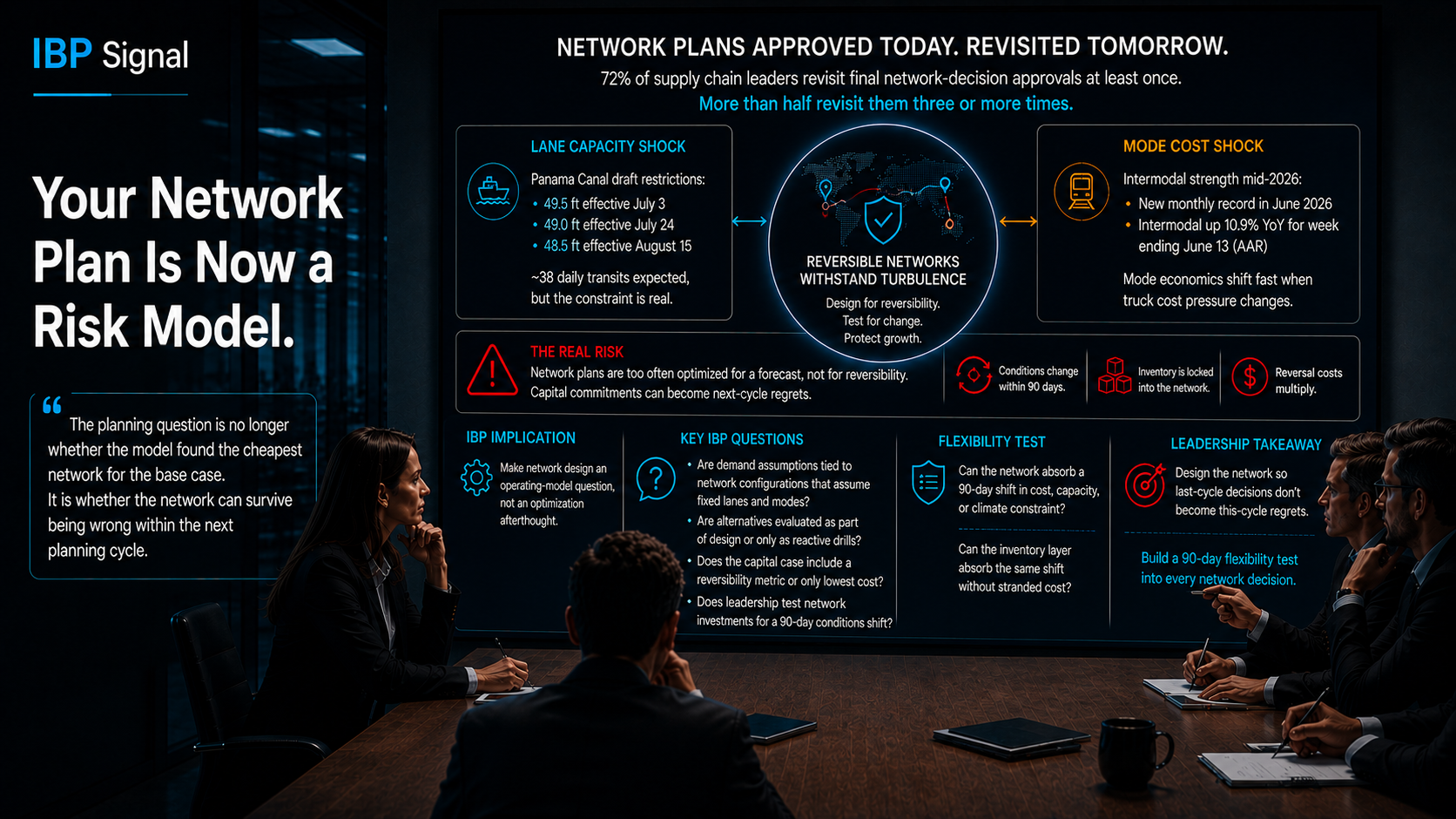
That is the real signal inside Gartner's recent finding, reported by DC Velocity, that 72% of supply chain leaders revisit final network-decision approvals at least once. More than half revisit them three or more times. The survey covered 151 supply chain leaders in November and December 2025, across companies with at least $250 million in revenue in manufacturing, life sciences, retail, and technology, with respondents in executive and senior operational roles.
That is not a footnote. It is a warning about how network decisions are approved. The usual interpretation is that the forecast changed or the team lacked data. That is too forgiving. The deeper problem is that many network plans are still optimized for a forecast rather than designed for reversibility. They treat lanes, modes, supplier geographies, and capacity commitments as stable enough to justify a lowest-cost answer.
Vicky Forman, Senior Director Analyst in the Gartner Supply Chain practice, frames the issue through networks that withstand turbulence and avoid letting geopolitical pressure override growth logic. Gartner's related report titles make the point directly: Supply Chain Executive Report: Build a Supply Chain Network That Withstands Turbulence and Let Growth, Not Geopolitics, Drive Supply Chain Network Decisions.
The planning question is no longer whether the model found the cheapest network for the base case. It is whether the network can survive being wrong within the next planning cycle.
That is why the Panama Canal matters here. It is not just a shipping story. It is a network-planning test.
According to ACP Advisory A-22-2026, issued July 1 and reported by gCaptain, the Panama Canal moved through a tightening draft sequence: 49.5 feet effective July 3, 49.0 feet effective July 24, and 48.5 feet effective August 15. The canal expected to maintain roughly 38 daily transits, but the constraint is real. A Transpacific or U.S. East Coast lane that looked viable in June may be less viable by August.
World Meteorological Organization confirmation that El Nino conditions have developed and are expected to strengthen rapidly adds the broader climate context, but the IBP point is simpler: lane capacity is not a fixed input. The planner who treated that lane as stable in the last S&OP cycle now faces a capital decision that should have been tested for reversibility before approval.
The same logic applies when the lane stays open but the mode economics change.
In U.S. surface transport, mid-2026 intermodal strength shows how quickly network assumptions can move when truck cost pressure changes the relative value of rail. AAR data showed intermodal volume hitting a new monthly record in June 2026, and FreightWaves reported intermodal up 10.9% year over year for the week ending June 13, citing AAR (Rail Industry Overview, July 6, 2026). The point is not that every shipper should move freight to rail. The point is that a network designed around one cost structure can become a capital-commitment mistake when the mode-cost structure shifts.
Panama is the lane-capacity shock. Truck-to-rail movement is the mode-cost shock. Together they expose the same weakness: network plans are too often approved as if current assumptions are durable enough to carry next-cycle commitments.
For IBP teams, this turns network design into an operating-model question. Are demand assumptions tied to network configurations that assume fixed lanes and modes? Are supply alternatives evaluated as part of the design, or only as reactive fire drills? Does the capital-commitment case include a reversibility metric, or only lowest cost? Does leadership approve network investments with a 90-day conditions-shift test?
IBP Implication
Those questions matter because the cost of reversal does not stop at the route map. Even when the network can be redrawn, the inventory sitting on that network usually cannot. Safety stock, in-transit inventory, regional buffers, and customer-positioned stock are all financial commitments layered on top of the network design. When a lane tightens or a mode shifts, that inventory does not automatically reprice, relocate, or become less obsolete.
So the flexibility test has two parts: Can the network absorb a 90-day shift in cost, capacity, or climate constraint? And can the inventory layer absorb the same shift without stranded cost?
This is where the capital discipline becomes practical. Network flexibility is not an optimization afterthought. It is the approval standard for decisions that lock up capital before conditions are fully knowable.
Leadership Takeaway
The leadership question for the next S&OP cycle is direct: which network decisions from our last S&OP cycle would we still make if conditions shifted within 90 days? The action is just as direct: build a network flexibility test into the next planning review. For every network decision, ask whether it can absorb a 90-day shift in cost, capacity, or climate constraint without requiring a full network redesign.
This is not about adding a generic contingency fund. It is about designing the network so last-cycle decisions do not become this-cycle regrets.
Sources
- DC Velocity: "Research highlights the need for flexible supply chain network planning" (2026-07-16).
- gCaptain: "Panama Canal Deepens Draft Restrictions as El Nino Strengthens" (2026-07).
- WMO El Nino confirmation via gCaptain coverage of ACP Advisory A-22-2026.
- AAR Rail Industry Overview, July 6, 2026; FreightWaves intermodal figure, week ending June 13, 2026.