Lead Signal: The Tariff Reset
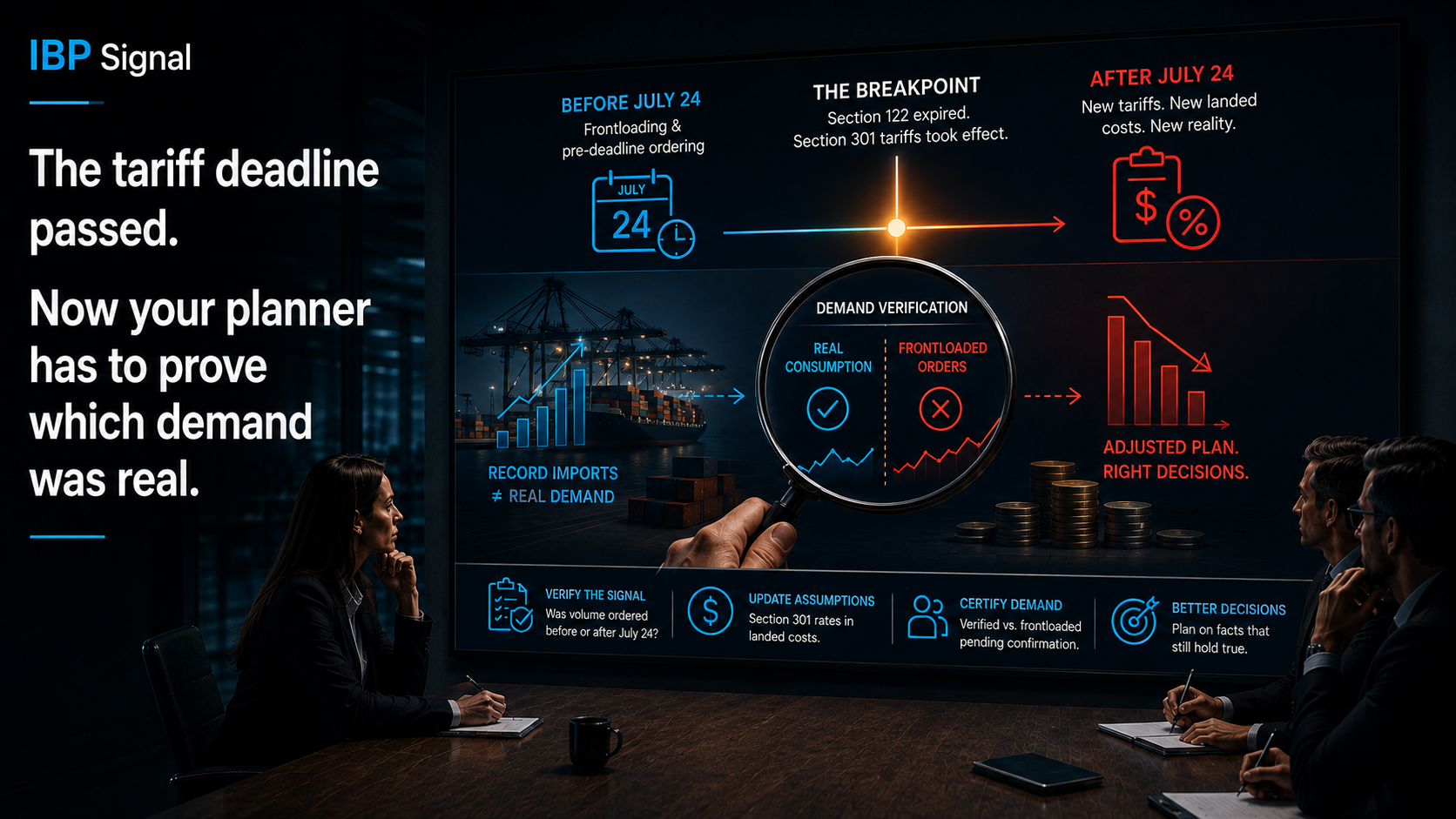
On July 24, 2026, the 10% Section 122 surcharge expired and new Section 301 tariffs took effect immediately. According to the U.S. Trade Representative, the duties now cover 60 economies and 99.4% of U.S. imports. This is not a policy update. It is a planning breakpoint.
UHY describes the shift as a "tariff reset": Section 122 is gone; Section 301 replaces it with 10% and 12.5% rates, layered over existing duties with exemptions and HTS classification complexity that planners now have to model into landed costs. That framing is advisory analysis. What matters for the planner is what changed on July 24.
The core IBP question is not what the tariff rate is. It is what the demand plan assumed the rate would be. After months of frontloading, the planner must now answer a harder question: which demand lines in the current consensus plan reflect actual consumption, and which are residual from pre-deadline ordering that assumed different landed costs?
The problem is not the tariff. The problem is the demand plan that was built on assumptions that expired with Section 122.
Pattern Detected: Record Port Volumes Are Not Demand
The operational proof is in the ports. The Port of Los Angeles handled 1,002,734 TEUs in June, its busiest June on record and only the third month ever above one million. Long Beach moved 779,331 TEUs, up 10.6%. The National Retail Federation forecasts 2.47 million TEUs for July, a new monthly record.
These are not structural consumption signals. They are the echo of pre-deadline ordering. As Jon Gold of the National Retail Federation put it: "It is extremely challenging because you just don't know what the tariff rates are going to be and who they're going to be applied to." Retailers plan six to twelve months ahead; constant tariff changes make long-term decisions difficult.
The distortion extends beyond finished goods. Even U.S. manufacturing expansion faces tariff exposure on imported equipment and components. The planner who treated the June import spike as "strong demand" now faces a Demand Review that must strip out the frontloading component, or overcommit capacity on a signal that has already reversed.
Tool Check: Did Your Demand Review Verify the Signal?
The Demand Review accepted volume as demand without asking whether it was consumption or pre-deadline ordering. That is an operating-model failure, not a forecasting error.
Three questions for the next S&OP cycle:
- Does our Demand Review distinguish between structural consumption and tariff-induced frontloading?
- Are landed-cost assumptions in the Supply Review updated to reflect Section 301 rates?
- Does leadership approve the demand plan with a frontloading-adjusted line, or only with a standard variance threshold?
KPMG's March 2026 tariff-resilience survey provides the baseline: 55% of companies are planning further price increases over the next year, and 34% are now passing on more than half of tariff costs, up from 13% in May 2025. The cost pressure is mature. The verification problem is not going away.
That pressure lands at the Demand Review / Supply Review handoff. If the Demand Review owner does not flag which lines are tariff-adjusted, the Supply Review assumes all demand is structural and commits capacity accordingly. One action: the Demand Review owner certifies a "verified demand" line and a "frontloaded pending confirmation" line before the handoff. Supply Review commits capacity only to the verified line.
Question Worth Asking
In our next S&OP cycle, which demand assumptions are based on actual consumption, and which are residual from pre-July-24 frontloading?
Add a tariff-adjusted demand verification gate to the Demand Review agenda. For every demand line, flag whether the underlying volume was placed before or after the July 24 breakpoint, and treat pre-breakpoint volume as requiring confirmation before it enters the consensus plan.
Operating Context: The Next Breakpoint May Not Be as Visible
The Conference Board notes that further tariffs on structural excess capacity and sectoral Section 232 investigations are likely. Brownstein had flagged the July 24 Section 122 expiry weeks in advance. Planners who watched that timeline had time to prepare verification frameworks.
The next breakpoint may not be as visible. If your Demand Review builds a one-time adjustment for July 24, you will rebuild it again in six months. The gate to add now is not a correction. It is a standing process.
This is not about panic. It is about proving which demand lines in the current plan are based on facts that still hold true.
One Number
99.4% — the share of U.S. imports now covered by Section 301 duties. When nearly every import-reliant supply chain is affected, the verification problem is universal, not niche.
Your Cycle This Week
Add tariff-adjusted demand verification to your Demand Review agenda this cycle. The VP Planning or IBP Process Owner owns the gate.
Sources
- USTR: Fact sheet on Section 301 action in response to forced-labor import rules (2026-07-24).
- UHY: "Tariff Reset: Section 122 Expires as Section 301 Duties Expand to 60+ U.S. Trading Partners" (2026-07-24).
- gCaptain: "Tariff-Driven Frontloading Pays Off as Trump Reinstates Global Import Duties" (2026-07-24).
- Dimerco: "Tariff Deadlines Reshape Supply Chain Planning" (2026-07-24).
- KPMG: 2026 tariff survey (2026-03-30).
- The Conference Board: "Forced Labor Tariffs-and More to Come?" (2026-07-24).
- Brownstein Hyatt Farber Schreck: "Trump Tariffs: Upcoming Deadlines" (2026-06-24).