Lead Signal
Your next S&OP cycle is about to inherit a geopolitical reset most teams never modeled.
On Friday, June 19, 2026, U.S. and Iranian leaders signed a 14-point memorandum of understanding in Switzerland. The deal aims to end the conflict in the Arabian Gulf and reopen the Strait of Hormuz, the chokepoint that carried roughly 20% of the world's crude oil before the war. The agreement starts a 60-day negotiating window for a final settlement and commits the U.S. to lift its naval blockade within 30 days. Oil export waivers are expected, $24 billion in frozen Iranian assets are scheduled for release, and a $300 billion economic development plan is on the table.
That is the headline. Here is what it means for planning.
Reopening a strait is not like flipping a switch. Analyst Lars Jensen estimates that full normalization will take two to three months. Fresh operator commentary makes the same point more sharply: NYK Line CEO Takaya Soga warned that Hormuz shipping may remain limited for months because lingering mines and low operator confidence continue to keep traffic below normal levels. Mines must be cleared. Backlogged cargo will surge simultaneously through a channel that has not handled normal volume in months. Empty-return patterns must renormalize. Insurance rates, which spiked during the closure, will not fall instantly. Bunker fuel prices, already volatile, will shift again as sanctioned Iranian crude re-enters the market.
The reopening is therefore not a resolution. It is a new operational state: partially open, partially congested, and politically reversible within 60 days if the follow-on talks fail. That risk is no longer theoretical. On June 25, a Singapore-flagged containership was hit off Oman after renewed Iranian transit warnings. One day later, SupplyChainBrain/Bloomberg reported that traffic was still moving, but the U.S. had facilitated only 80 ship crossings across June 23 and 24 versus a pre-war average of 138 vessels per day.
This matters for IBP leaders because the strait was treated as an exception, not a scenario. For months, planning teams rerouted around the Cape of Good Hope, absorbed fuel surcharges, and extended safety stock. U.S. container import volumes still rose 6.6% in May, reaching 2.43 million TEUs. Demand did not wait for the strait to reopen. That is the critical point: the supply chain adapted without the strait. Now the strait is coming back, and the adaptation must be undone, adjusted, or retained under a new set of constraints.
The question is not whether the strait reopens. The question is whether your IBP cycle has a protocol for reintegrating a major lane that was assumed lost.
IBP Implication
Most IBP cycles treated the Hormuz closure as a temporary disruption to be waited out. That assumption is the planning gap.
When a lane closes, resilient teams model three things: the immediate workaround, the cost of the workaround, and the conditions under which the lane returns. Most teams did the first two. Few did the third. The result is a structural problem: the IBP cycle has no Reconciliation agenda item for "reopening scenarios." Demand Review may have adjusted forecasts. Supply Review may have rerouted lanes. But neither meeting likely documented the decision rules for when to revert, when to stay rerouted, and what volume spike to expect when the channel reopens.
The cost of inaction is a cargo surge that arrives before the planning system has updated its assumptions. Vessels that were held in port will move at once. Slots that were reallocated to Cape routes will compete with strait-bound bookings. The teams that built scenario discipline during the closure will have decision trees ready. The teams that managed week-to-week will face the same chaos in reverse.
Leadership Takeaway
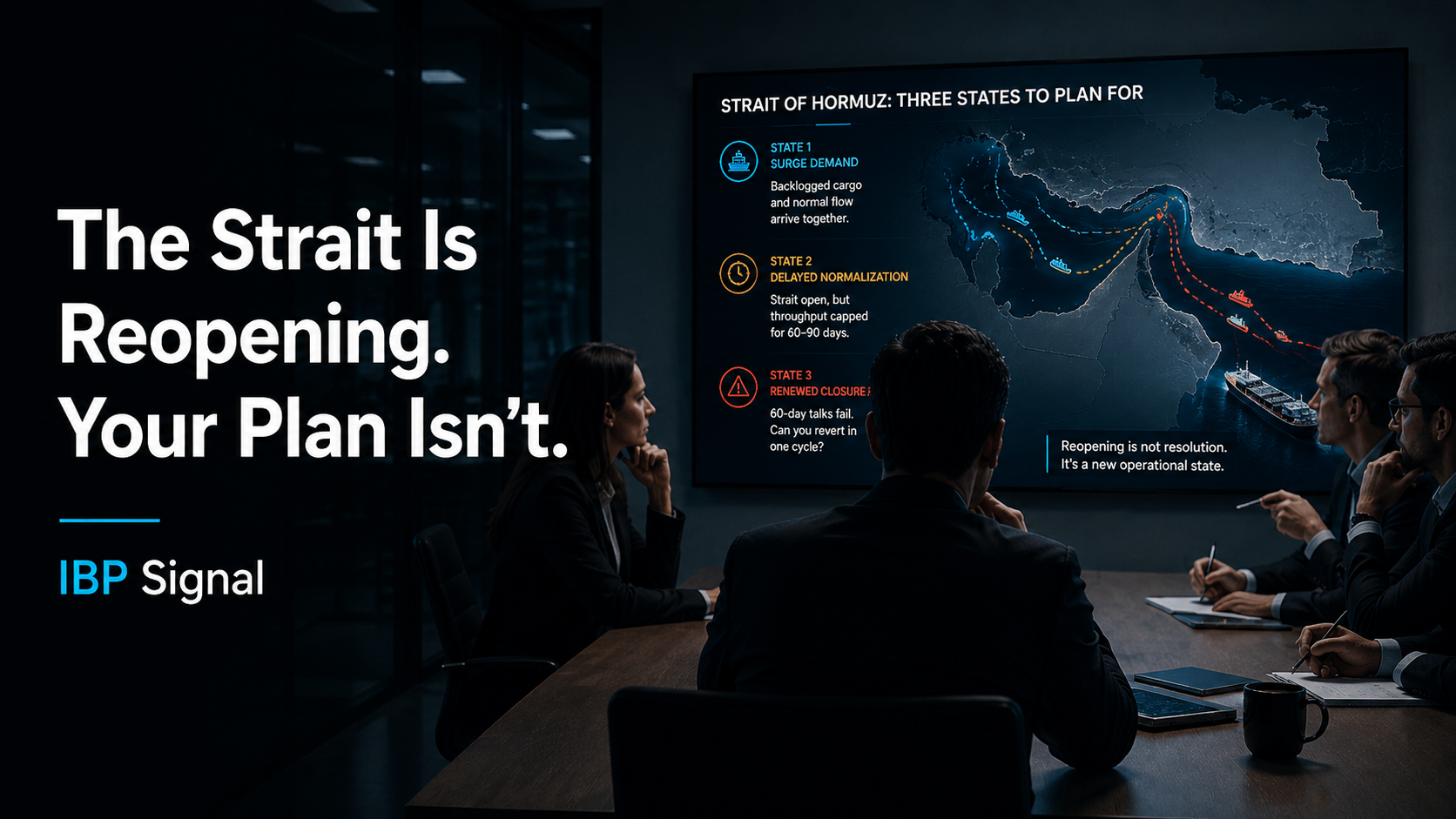
One actionable understanding: Reopening is a scenario, not a solution. The strait may be open, partially congested, or closed again within months. Your cycle must model all three states simultaneously.
One question to ask in the next Reconciliation: "Which contingency decisions did we make during the closure, and what is our trigger for reversing, retaining, or modifying each one?"
One immediate action: Before the next Demand Review, run a three-state stress test against your current supply plan. Model surge demand, delayed normalization, and renewed closure risk. Compare the output to your current baseline. If the baseline only assumes "open and normal," it is not a baseline. It is a blind spot.
Scenario Test: Three States Your Next Demand Review Must Model
The strait is not binary. Your next Demand Review should stress-test the supply plan against three simultaneous states, not one optimistic baseline.
State 1: Surge demand. Backlogged cargo and normal flow arrive together. Model the peak weekly volume your lanes and ports can absorb before congestion triggers secondary delays.
State 2: Delayed normalization. The strait is open but throughput is capped for 60 to 90 days. What is your trigger to keep Cape routing active instead of reverting immediately?
State 3: Renewed closure risk. The 60-day talks fail. Can your current plan revert to contingency mode in one cycle, or does it require a full replan?
If your baseline only assumes "open and normal," you have one scenario and two blind spots. But knowing what to model is only half the discipline. The other half is knowing what not to dismantle.
What Not To Do: The Reopening Trap
The most dangerous response to a reopened strait is to cancel all contingency plans. Treating reopening as a reset button erases the institutional memory of what worked during the closure and leaves the organization exposed if the channel closes again.
Do not dismantle Cape routing contracts on day one. Do not drop safety stock to pre-crisis levels before normalization is confirmed. Do not remove the Hormuz scenario from the Risk Register because the headline says "open."
Reopening is a new phase of the same risk, not the end of it. The teams that keep their contingencies warm will be the ones that survive the next reversal.
Sources
- FreightWaves: "How the 14-Point U.S.-Iran MOU Could Reshape Global Supply Chains"
- FreightWaves: "U.S.-Iran Peace Deal Reopens Strait of Hormuz"
- Financial Times: "Mines will hold back Strait of Hormuz shipping for months, CEO warns"
- gCaptain: "Ship Hit Off Oman After IRGC Renewed Hormuz Transit Warnings"
- SupplyChainBrain / Bloomberg: "Traffic Flows Through Hormuz Despite Shock Ship Attack"
- Descartes / The SC Exchange: "U.S. Container Import Volumes in May Increased by 6.6%"