Lead Signal
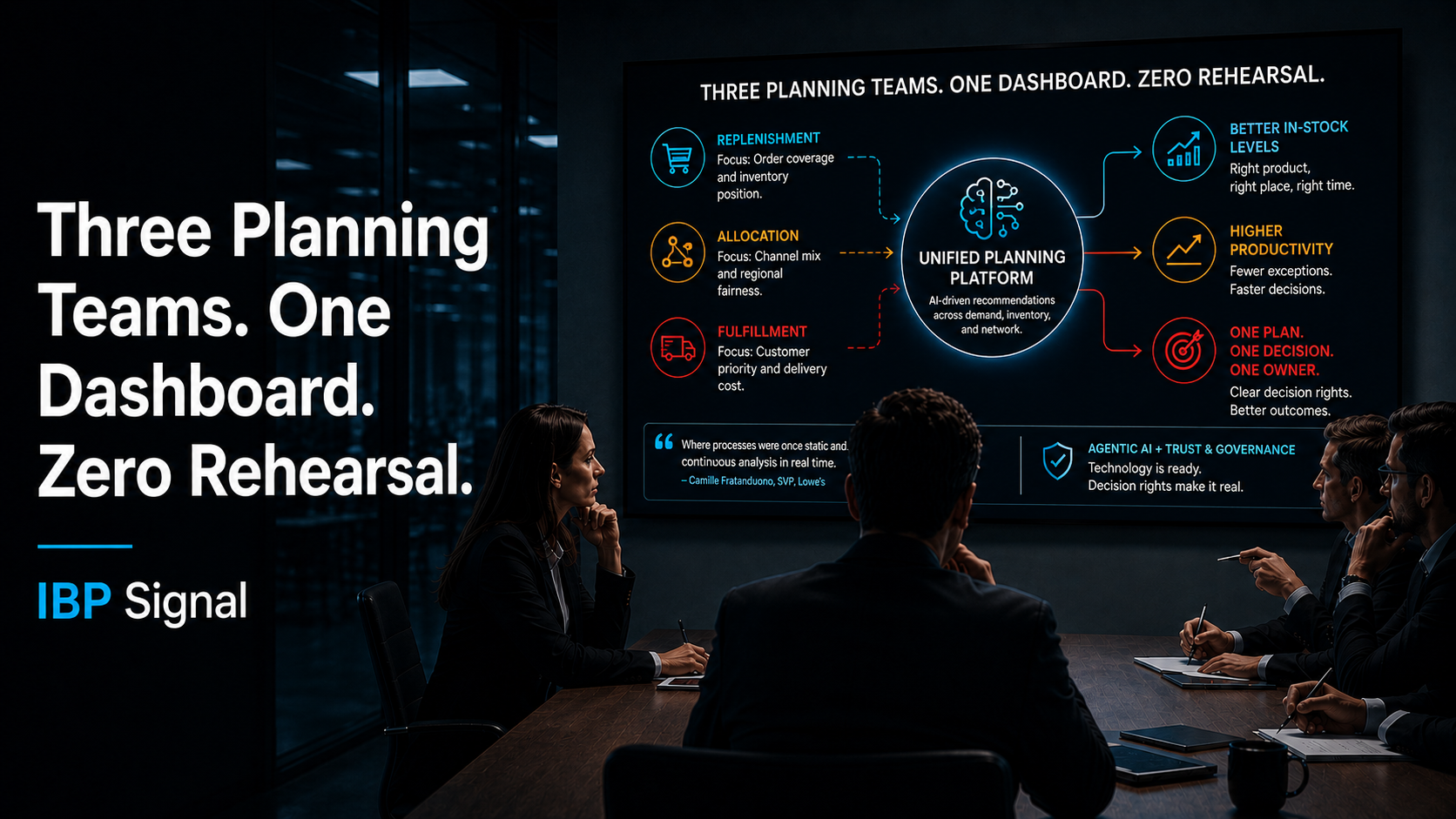
Lowe's is expanding its partnership with RELEX Solutions to connect forecasting, replenishment, and allocation into a single AI-driven planning platform. Full implementation is slated for early 2027. The stated goal is straightforward: improve in-stock levels while driving productivity across the inventory network.
The operational details matter. Lowe's SVP Camille Fratanduono describes the shift in decision-making terms, not technology terms. Where processes were once static and reactive, the new platform enables continuous analysis of demand, inventory, and network conditions in real time. The output is not just visibility. It is "clear, actionable recommendations on where inventory should go, how much to send, and when to move it."
That sounds like a vendor success story. It is also an organizational experiment most companies will struggle to replicate.
Here is why. In most planning organizations, replenishment, allocation, and fulfillment are owned by different teams with different KPIs, different S&OP review rhythms, and different escalation paths. Replenishment worries about order coverage and safety stock. Allocation worries about channel mix and regional fairness. Fulfillment worries about customer-segment priority and last-mile cost. Each team makes locally rational decisions. The problem is that locally rational decisions, made in isolation, create globally suboptimal inventory positions: excess in one region, stockouts in another, and a fulfillment team that overrides both because a VIP customer just called.
Lowe's move is not just a platform upgrade. It is an operating-model change that assumes those three teams can now operate from one set of data, one set of recommendations, and, critically, one set of decision rights. The technology makes the first two possible. The organization must deliver the third.
Gartner's Top Supply Chain Technology Trends for 2026 supports the technology-readiness side: agentic AI and physical AI are named trends, with trust and governance as the third theme, the one most IBP leaders underweight because it is hardest to implement.
RELEX's agentic AI capability illustrates the gap. The system runs overnight root-cause analysis and scenario generation; planners arrive to pre-diagnosed exceptions. But this only works if the planner has authority across replenishment, allocation, and fulfillment boundaries. If each exception still routes to three separate managers, the speed gain is lost to coordination overhead.
The signal is not that Lowe's bought better software. The signal is that Lowe's is betting its inventory operating model can absorb unified planning faster than its competitors can reorganize their decision rights.
IBP Implication
Most IBP leaders treat technology investments as capability gaps: better forecasting, visibility, automation. The real gap is structural. Your S&OP cycle was built for siloed decision-making. Unifying the data layer without unifying the decision layer creates a dangerous middle state: planners see cross-functional conflicts but lack authority to resolve them.
Current IBP governance assumes replenishment, allocation, and fulfillment are reviewed in separate forums before reconciliation. A unified platform collapses those forums into one view, but if decision rights remain unchanged, the technology becomes an expensive argument starter. Every exception comes with clear cross-functional evidence and no cross-functional owner.
The cost of inaction is competitive. Retailers who build unified decision rights early will out-cycle competitors still routing exceptions through three approval chains. The penalty is not a failed implementation. It is the loss of responsiveness to customers who expect in-stock precision and who will switch to suppliers whose planning organization operates as one system, not three.
Leadership Takeaway
The technology is available now. The organizational design is not. Before your next S&OP cycle, map whether replenishment, allocation, and fulfillment are treated as one conversation or three.
The question to ask in your next Executive IBP meeting:
When our planning platform flags a conflict between replenishment safety stock and allocation channel priority, who makes the call, and do they have the authority to override both teams without escalating to the executive level?
The immediate action:
Run a one-hour decision-rights mapping exercise with the three planning team leads. List the five most common cross-functional exceptions. For each, write down: who currently decides, who they escalate to, and what would change if the decision were made at the unified-planning level. You are not reorganizing the org chart. You are looking for the single exception that costs the most time and inventory, and who should own it.
GOV: Decision-Rights Mapping
Unified planning platforms expose cross-functional conflicts in real time. The technology is only as fast as the decision rights behind it. Here is a one-hour exercise to find the bottleneck before the platform goes live.
Bring together the leads for replenishment, allocation, and fulfillment. List the five cross-functional exceptions that cost the most inventory and time. For each, map who sees it first, who decides, who they escalate to, and how long the loop takes. Then ask: if one planner with full visibility could decide, what authority would they need? Pick one exception and test the new path in the next S&OP cycle. Most teams discover that 80 percent of the delay sits in two handoffs no one designed. The exercise requires naming the owner, not reorganization.
WATCH: Early Indicators That Your Unified Planning Is Drifting
A unified platform can look healthy while the organization silently reverts to siloed behavior. Monitor these four signals in your next three S&OP cycles:
1. Exception volume up, resolution time flat. More conflicts surfacing with unchanged decision speed means the data layer is unified and the decision layer is not.
2. Shadow spreadsheets reappearing. Offline "check" models mean the platform lost trust, usually because recommendations were overridden without explanation.
3. Team-level KPIs diverging from unified output. If replenishment still optimizes for coverage, allocation for channel mix, and fulfillment for cost per shipment, the platform generates one plan and the organization executes three.
4. Escalation paths lengthening. New exceptions should route to a single owner. If they are copied to three managers and a steering committee, the old decision structure is eating the new technology.
One of these four will move first. Your S&OP reviews must detect it before the platform does.
AVOID: The Software-Upgrade Trap
The most dangerous response to a unified planning initiative is to treat it as an IT project with a go-live date.
Do not write the business case around forecast accuracy alone. A better algorithm feeding into three separate review meetings still produces three separate plans.
Do not define success as "all teams on one dashboard." Visibility without authority creates the dangerous middle state: planners see the conflict, report it, and wait for someone else to decide.
Do not schedule training as the change-management phase. Training teaches buttons. The operating-model change teaches who presses them and who owns the output.
Do not let the vendor define the governance blueprint. Every platform can unify data. None can unify your decision rights without your input.
The teams that treat unified planning as an organizational redesign with a technology component will out-cycle the teams that treat it as a technology upgrade with a training component. The software is the smallest part of the transformation.
Sources
- Supply Chain Dive: "Lowe's taps tech to unify inventory planning, replenishment" (2026-04-24).
- Gartner: "Top Supply Chain Technology Trends for 2026" (2026-06-30).
- RELEX Solutions: "Agentic AI for supply planning" (2026-05-22).